

You’re at a crossroads many growing businesses face: your technology needs are outgrowing the “figure it out as we go” approach, but you’re not sure whether to bring someone onto the team full-time or partner with an outside provider.
It’s a practical question with real financial consequences. A poor IT decision can drain your budget, leave gaps in coverage, and create frustration for your team. A good one keeps systems humming, protects your data, and scales smoothly as you grow.
Let’s break down the costs, capabilities, and tradeoffs of outsourcing IT to a managed service provider versus hiring internal staff, so you can make an informed choice for your business.

The True Cost of Hiring an In-House IT Employee
When most business owners think about hiring IT staff, they focus on salary. But the real expense goes much deeper.
Base salary and benefits
A mid-level IT professional in Missouri typically earns between $60,000 and $85,000 annually.[1] Add employer-paid benefits like health insurance, retirement contributions, payroll taxes, and paid time off, and you’re looking at an additional 25 to 40 percent on top of that salary. That brings the total annual cost to roughly $88,000 to $120,000 per employee.[1]
Ongoing training and certifications
Technology changes fast. Keeping an internal IT person current requires continuous education. Expect to budget $2,000 to $5,000 per year for training, certifications, and conferences.[2]
Limited coverage hours
One person can only work so many hours. If your IT staff member is sick, on vacation, or leaves the company, you’re left scrambling. Coverage gaps mean delayed responses, longer downtime, and frustrated employees. The average tenure of IT professionals in small and medium businesses is now under three years, which means you’ll face recruiting and onboarding costs more often than you’d like.[3]
Narrow skill set
A single IT generalist can handle everyday issues like password resets, printer troubles, and basic network problems. But what happens when you need cybersecurity expertise, cloud migration guidance, or help with compliance requirements like HIPAA or PCI? Hiring specialists for each niche skill isn’t realistic for most SMBs, which leaves you vulnerable when specialized needs arise.[4]

What Managed IT Services Cost (and What You Get)
Managed service providers work on a subscription model. For most small businesses with 10 to 50 employees, monthly fees typically range from $2,000 to $7,000, depending on the size of your team and the services included.[5]
That flat monthly rate usually covers:
- 24/7 monitoring and support – Issues are often caught and resolved before you even notice them.
- Help desk access – Your team gets support whenever they need it, not just 9 to 5.
- Proactive maintenance – Regular updates, patches, and system checks reduce the risk of outages.
- Security and backup – Managed providers stay current on threats and ensure your data is protected and recoverable.
- Access to a full team – You’re not relying on one person. You get network engineers, cybersecurity specialists, and cloud experts when you need them.
Industry data shows that businesses using managed IT services see downtime reductions of more than 85 percent compared to reactive break-fix support.[6] For context, downtime costs small businesses an average of $427 per minute in lost productivity, sales, and recovery expenses.[7]
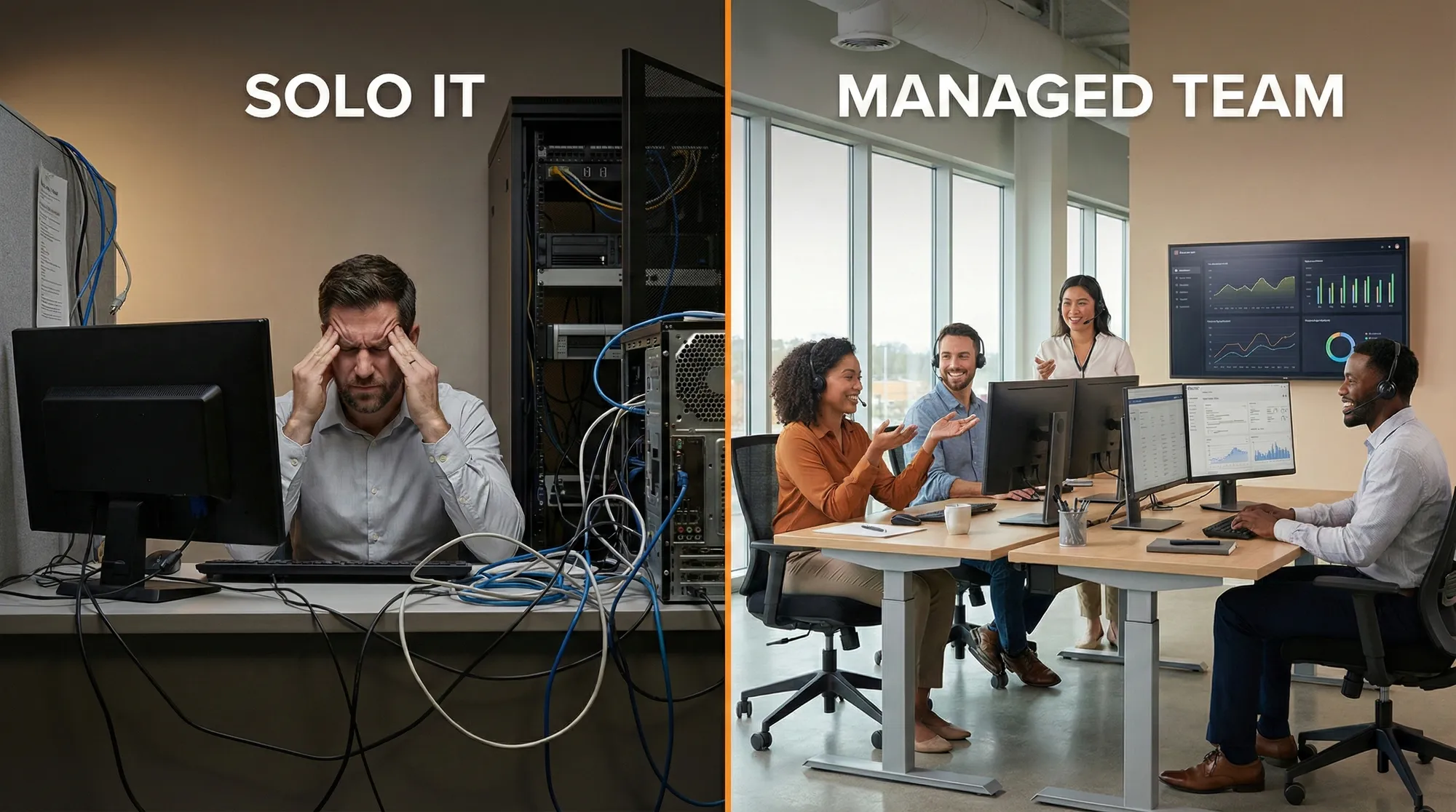
Side-by-Side Comparison: In-House vs Outsourced IT
| Cost or Feature | In-House IT | Outsourced (Managed IT) |
| Annual salary/fees | $88,000–$120,000+ per employee | $24,000–$84,000 annually (flat-rate monthly service) |
| Benefits & overhead | 25–40% of salary | Included in service fee |
| Training & certifications | $2,000–$5,000/year per person | Included |
| Coverage hours | Limited to business hours; gaps during PTO/sick leave | 24/7 monitoring and support |
| Breadth of expertise | One or two skill areas | Full team of specialists |
| Scalability | Requires additional hires | Flexible; adjusts with your growth |
| Security & compliance tools | Must purchase separately | Typically included or bundled |
Sources: Cost data compiled from industry benchmarks and managed service pricing guides published in 2026.[1][5][2]
For businesses with fewer than 250 employees, outsourcing typically delivers 18 to 22 percent lower total cost of ownership over a five-year period.[8]

When Hiring In-House Makes Sense
Outsourcing isn’t always the best fit. Here are scenarios where bringing IT staff onto your team may be the smarter move:
- You need constant on-site support – If your operations require someone physically present throughout the day (for example, manufacturing environments with specialized equipment integration), an internal person may be necessary.
- You have highly specialized or proprietary systems – Unique software or custom-built systems sometimes require deep, day-to-day familiarity that only an internal employee can provide.
- You have the budget and volume – Larger organizations with 400+ employees and complex IT environments often benefit from a hybrid model: internal leadership and strategic roles supported by outsourced specialists.

When Outsourcing IT Makes Sense
For most small and mid-sized businesses, outsourcing is the more cost-effective and capable option. It makes sense if:
- Your IT needs are growing but unpredictable – Managed providers scale with you. No need to hire, onboard, and train when demand spikes.
- You want predictable costs – Flat monthly fees make budgeting simple. No surprise overtime, benefits increases, or turnover costs.
- You need expertise beyond what one person can offer – Cybersecurity, cloud strategy, compliance, network engineering—outsourced providers give you a full bench.
- Downtime is costly – Proactive monitoring and 24/7 support drastically reduce outages.[6]
- You’d rather focus on your business – Partnering with a managed provider frees you and your team to concentrate on what you do best.
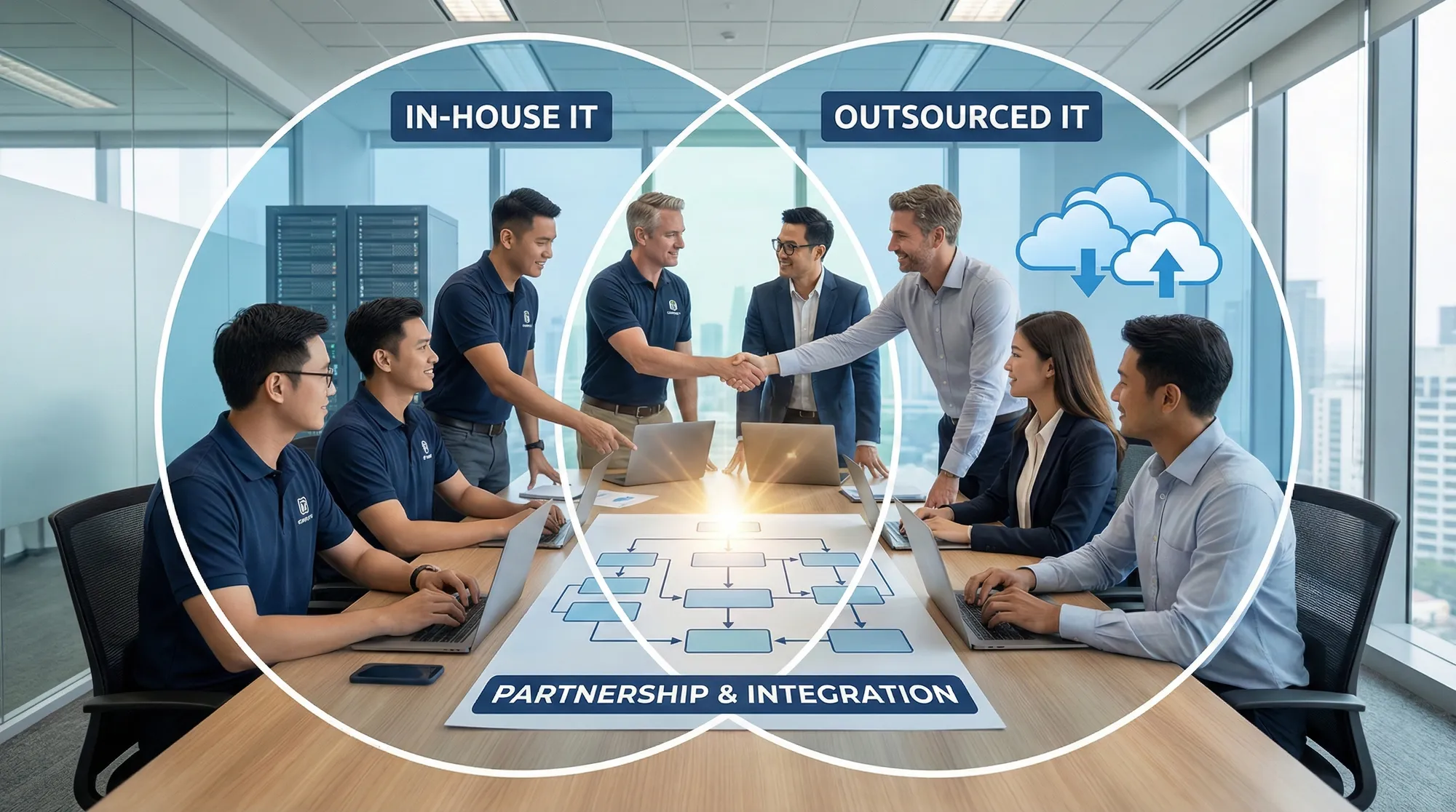
The Hybrid Approach: Best of Both Worlds?
Some mid-market businesses choose a middle path: they hire one internal IT coordinator to handle day-to-day tasks and act as a liaison, then outsource specialized work like cybersecurity, cloud management, and after-hours support to a managed provider. This co-managed model can work well if you have the volume and budget to support it, but for most SMBs under 100 employees, full outsourcing tends to be simpler and more cost-effective.[9]

Making Your Decision
- What’s your realistic IT budget? If hiring one full-time employee would stretch or exceed your budget, outsourcing is likely the better path.
- How critical is uptime to your operations? If an hour of downtime costs you thousands in lost revenue or productivity, 24/7 monitoring and rapid response become essential.
- Do you have specialized compliance or security requirements? Regulations like HIPAA, PCI, or data privacy laws often require expertise that’s expensive to maintain in-house.
- How fast are you growing? If headcount or locations are increasing, outsourced IT scales with you without the lag of recruiting and onboarding.

What to Expect from a Local Managed IT Partner
If you decide outsourcing makes sense, look for a provider who:
- Offers transparent, flat-rate pricing – No surprise bills or nickel-and-diming.
- Provides local, responsive support – You want a partner who understands your region and can be on-site when needed.
- Has a track record with businesses like yours – Ask for references from clients in your industry and size range.
- Includes proactive monitoring and security – Reactive break-fix support isn’t enough in 2026. You need a provider who prevents problems, not just fixes them.
- Gives you a clear service-level agreement (SLA) – Response times, uptime guarantees, and escalation paths should all be documented.[6]
Conclusion
At Pinpoint Tech, we’ve worked with SMBs, healthcare practices, schools, and municipal offices across North-Central Missouri for years. We know the challenges small businesses face, and we’ve built our managed IT services to give you enterprise-level support at a price that makes sense. If you’d like to talk through your specific situation, we’re happy to walk you through the numbers and options with no pressure.
Ready to explore your IT options? Schedule a free consultation with Pinpoint Tech and let’s figure out what makes sense for your business.

FAQs
How much does it cost to hire an in-house IT person?
A mid-level IT employee typically costs between $88,000 and $120,000 per year when you include salary, benefits, taxes, and training. That figure covers one person with limited hours and a narrow skill set.
What does managed IT service cost for a small business?
For businesses with 10 to 50 employees, managed IT services generally range from $2,000 to $7,000 per month, depending on your team size and the scope of services. Most providers offer flat-rate pricing that includes monitoring, support, security, and maintenance.
Can I have both in-house IT and outsourced support?
Yes. Some mid-sized businesses use a hybrid or co-managed model, where they employ one internal IT coordinator and outsource specialized services like cybersecurity and after-hours support. For most SMBs under 100 employees, however, full outsourcing is simpler and more cost-effective.
What are the biggest downsides of in-house IT?
The main drawbacks are high fixed costs, limited coverage hours, narrow expertise, and turnover risk. When your internal IT person is out sick, on vacation, or leaves the company, you’re left without support until you hire and train a replacement.
How do I know if outsourcing IT is right for my business?
Outsourcing usually makes sense if you need predictable costs, 24/7 support, access to multiple areas of expertise (like cybersecurity and cloud services), and the flexibility to scale as you grow. If your IT needs are straightforward and you have the budget for a full-time salary plus benefits, in-house may work—but most SMBs find managed services more capable and cost-effective.